


![[eBook] Sustainability and water management](https://agriplasticscommunity.com/wp-content/uploads/8_550x310_ENG-440x264.png)
![[eBook Trends in Agriculture Plastics] Increasing use of biodegradable mulch](https://agriplasticscommunity.com/wp-content/uploads/550 × 310_2_ENG-150x150.png)
![[eBook Trends in Agriculture Plastics] Reducing the plastic used in the manufacture of agricultural films](https://agriplasticscommunity.com/wp-content/uploads/550 × 310_1_ENG-150x150.png)






Grain storage equipment: trends, challenges and how to choose the right one
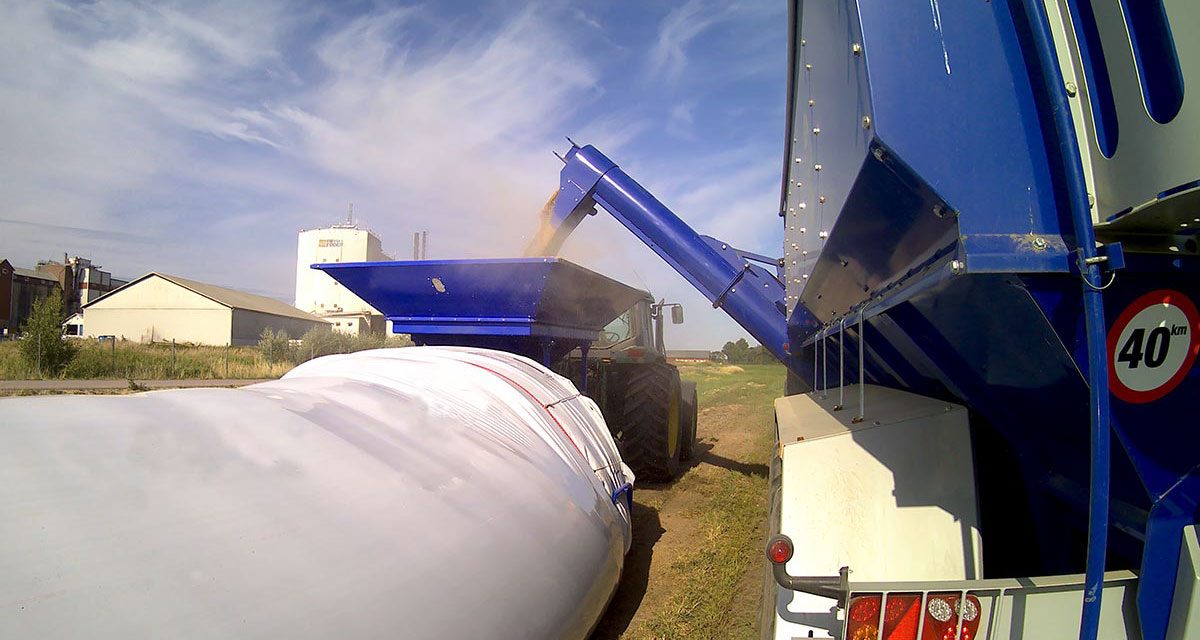
Interview with John Wierenga of Neeralta Manufacturing
In this post, we will talk about grain storage and the different equipment needed to carry out this procedure. To do so, we have transcribed an episode of our podcast presented by our colleague at SPR Packaging, Trevor Wells, interviewing John Wierenga, co-owner of the Canadian company Neeralta Manufacturing, which specializes in all types of equipment for loading and unloading grain, augers, and similar equipment.
In previous episodes of our podcast, we spoke with Maruzaan Booyse, an expert in animal nutrition and silage products from the Armando Alvarez Group, who talked to us about temporary grain storage options and how to preserve grain in silo bags, the types of products that can be stored, and the different types of machinery used, including grain balers, which we will focus on in this article.
John Wierenga has been in the agricultural machinery business for over 15 years as a supplier in Canada, one of the world’s leading countries for grain bagging, along with the United States and Australia.
Trends in grain packaging and storage
Regarding trends in grain packaging and storage, John comments: “What we hear all the time is instant storage. If you have a bumper crop this year and are very limited in terms of storage, you will need a temporary option. That’s where the silo bag comes in as an option for temporary grain storage. In this case, and in general, you will only need two people to install the grain bag and instantly have an additional 13,500 bushels of storage capacity. I am using a 10-by-300 bag as an example, because that is approximately what can fit in a 10-by-300 bag, 13,500 bushels.”
John explains that harvesting has a very limited window of opportunity, especially in the United States, where harvesting can last from 4 to 6 weeks, possibly even a little longer. He is referring mainly to corn. In the case of Saskatchewan and Alberta in Canada, the harvest window is mostly 3 weeks to a month. So grain bag storage is a very useful tool at harvest because it is instantly available, with the ability to place the bag wherever you want. This solves another current problem, which is labor shortages. “If you have a grain baler in the field with you and you have a grain cart, you can simply dump the grain into the bag with the baler instantly and get on-site storage, instead of having to find more trucks, more people, which increases labor costs… It’s about meeting the farmer’s needs.”
Challenges when using silo bags for grain storage
Regarding the main reasons why farmers do not use silo bags for grain, John comments: “The main complaint we hear is related to wildlife, whether it be raccoons, deer, or bears… What we recommend to people, depending on their specific situation, is that if they know they are committed to long-term storage, they should try to store in the same area every year. You can put up a fence where you can drive in with your semi-trailers and empty the bags, so it’s a one-time expense… The other issue we have is the installation of the bags. This also raises some concerns that we hear from customers, especially in relation to the 12 by 500 bag, which is the largest silo bag on the market.
John comments that when they market their equipment, they always explain to farmers that it is very important to understand that this is a temporary grain storage method. It is essential to monitor the silo bags and supervise the harvest because it is a large investment. “Let’s say you have a bag of canola. I believe canola prices have reached $20 per bushel. You can do a very simple math calculation: 20 times 13,500 equals about $270,000 worth of product in one bag.”
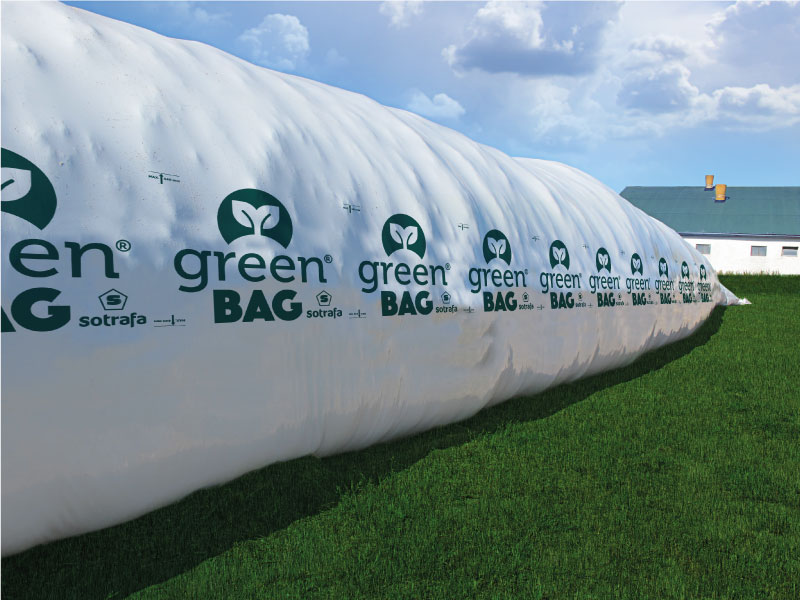
Silo bag: GreenBag
How to choose the size of the silo bag and the necessary baling equipment?
When it comes to silo bags, there are two or three determining factors that differentiate them. The diameter of the bag that would fit in the tunnel of the packaging equipment, the length, and the thickness of the bag. We asked John, based on his experience, what are the determining factors that farmers evaluate when deciding what size bags and machinery to buy.
John comments: “In our case, we manufacture 10-foot and 12-foot baling equipment, and what is quite unique about our equipment is that if you buy one of our 12-foot grain balers, you will be able to do both. For example, we have a telescopic tunnel, so you can put a 10-foot bag or a 12-foot bag on it, which is wonderful when it comes to transportation because you can go down the highway in 10-foot mode, eliminating a lot of problems with truck drivers, etc. If someone calls us saying they have no baling experience, I mainly advise them to buy 10-foot baling equipment. That’s probably more than 90% of our market.
John gives two reasons for choosing 10-foot balers. On the one hand, the initial investment is significantly lower when purchasing 10-foot baling equipment, and on the other hand, the weight of the bag is lower, making it easier to install. When you have limited labor capacity to help on the farm, it is much easier to fill a 10-by-300 bag than a 12-by-500 bag. We are talking about almost 400 pounds versus 900 pounds more.
John adds, “For a small farmer, a 10-by-300 bag is a very common size, and people often equate it with the number of bushels they get from a quarter of land. If you have a wheat crop multiplied by 80 bushels, the rough math would be: one 10-by-300 bag for every quarter of land, which would be 160 acres. And as for the weight of the bag, for a smaller operation, 10-foot bags work very well, while 12-foot balers are for large operations.”
In summary, the determining factors would be the size of the operation and the workforce you have available to deal with the initial setup
An added value of Neeralta’s equipment is that it prepares used grain silo bags so that they are in the best possible condition to be collected and recycled in the markets where they operate.
John adds about recycling trends: “In Canada, there are programs and collection points where rolled-up bags can be returned for recycling. Some companies have already been actively using rolled-up bags, and the process involves reusing them to manufacture other products. So there are some very positive developments in this regard.”
We invite you to learn about Sotrafa’s Greenbag solution for temporary grain storage, also marketed by SPR Packaging in the United States and Canada.
If you have questions about which grain storage machinery or baler to choose and the right silo bag, our team of experts can advise you.